

The concept
Usually three levels of listening are distinguished and listening on all three can be called “advanced listening”.
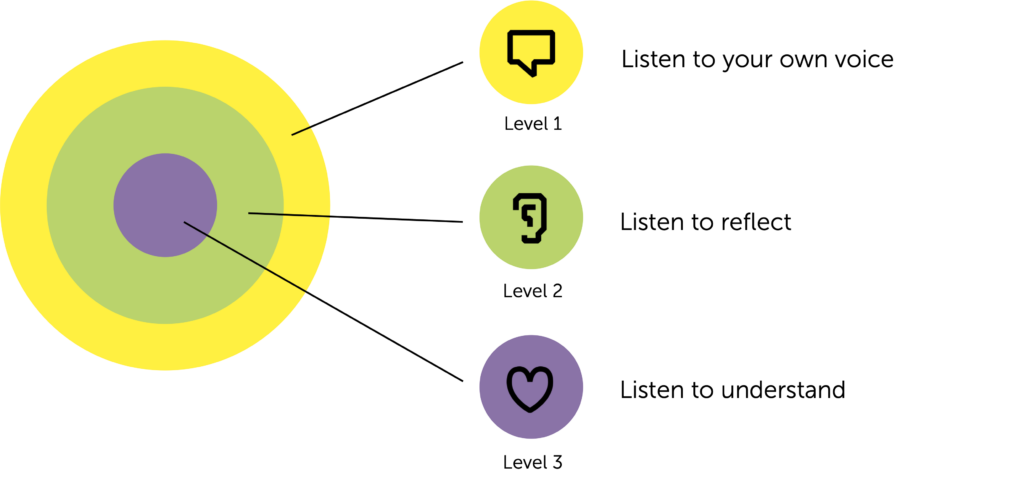
Level 1:
In everyday life we usually listen at this level. The moment we perceive the voice of another person, our brain starts to interpret, filter out or add information. The new information received from a conversation partner is put into complex contexts. This means that on one level we take in “raw material” of sensory impressions and at the same time the information is enriched unconsciously with interpretations that make sense to us.
Because of that our understanding of what the other person says is very easily biased. Consequently, we do not listen to our partner, but to our inner voice. In this moment we hear our own opinion and relate to our own experiences from the past. We are influenced by our own needs or judgements. You may hear the words, but at the same time you are talking to yourself in your head.
Level 2:
Listening to reflect. This kind of listening is “simple” but not “easy”. On this level we perceive our counterpart fully. We pay attention not only to what he/she says, but also to how it is said. We pay attention to the mood of the other person in his or her narrative. This level is best described using the example of a first date. We pay close attention to every nuance of our partner. We are directed with all our antennas towards reception and pay attention to every word and even the smallest signs.
Level 3:
Listening to understand. In general, people perceive a closeness to their conversation partner when the so-called “wavelength” is right. Then it is easy for us to understand the stories of others, because we have similar experiences, follow similar values and come from the same cultural background. But then we likely to fall back into our own stories and quickly find ourselves back at level 1.
Level 3 is more about being highly conscious. Here it is more important to understand the inner attitude of the communication partner: what has shaped him or her (culture, society, values), what makes them narrow-minded or prompts them to take a certain perspective on the world. The point here is simply to perceive and to put it into an overall context. Hypotheses are formed which need to be neither right nor wrong. Do not judge and keep calm. Here it is a matter of perceiving, enjoying differences, enduring and staying with the other person with the whole focus.
Step-by-Step Instructions
Exercise for understanding Level 1
The facilitator tells the participants a short story. Afterwards the participants receive a piece of paper (see the questionnaire in the download section) with 10 statements which they should answer with “right” or “wrong”. They have 1 minute to do so.
The story: “A supervisor talks to a team member about complying with the office hours. The employee is convinced that he has not done anything wrong. If he comes to work after 7.30 am, he always stays longer after 4:30 pm. The supervisor suggests that he should write down the working hours in the future. The employee agrees under the condition that all colleagues make such lists, too.”
Solution for the facilitators and later to share with the participants
- The supervisor calls her team member to speak to her.
= Don’t know - The supervisor is annoyed by the employee’s tardiness.
= Don’t know - The supervisor monitors the arrival times of the colleague for a while.
= False - The colleague has been arriving late more often recently.
= Don’t know - The colleague proves that he has never been present less than required.
= False - The proposal is to write down the daily attendance.
=True - The employee agrees to the proposal.
= False
Evaluation: It is possible that none of the participants find the right solution. This shows that we all listen to our own story.
Exercise for two people to strengthen Level 2
Person A tells a story that is or was moving for him/her.
Person B uses the method of “emotional mirroring”. B reflects the perceived mood in his or her words; e.g. “… that certainly annoyed you in the situation/ you were worried/unsure etc…”. At the same time B tries to reflect a similar “vibration” in sound, expression and facial expression (non- verbal) while remaining authentic.
Evaluation: If we listen to the “What” aspect of the conversation partner and pay at the same time attention to the “How” aspect, we get more involved in the other person’s story and do not stick to our own interpretations.
Exercise for 3 people
Person A tells a more or less complex story what has happened to him/her. A and B collect hypotheses about values, norms, experiences of person A. Afterwards there is an open exchange about it.
Conclusion
More training of this ability will lead to a higher quality of communication. People will feel understood and there will be fewer misunderstandings. It should be emphasized at this point, however, that it is really difficult to acquire this ability. Those who do not find it difficult should know that they are probably still listening at level 1 or that they have an extraordinary talent.
Sources
The model is developed by mermaid & broccoli based on Stephen Covey, Rob MacNamara and Co- Active.
RELATED METHODS
Superpower MirrorTransformation Map
Team Clarity Canvas
My Favorite Photo