
Background information
Rooms are never neutral. They influence behavior, creativity, participation, and decision-making quality.
A U-shaped setting signals: “There is a front and a back here.”
A circle of chairs says: “We are all on equal footing here.”
Bar tables whisper: “Think fast.”
Sofa corners murmur: “Let’s go deeper.”
When people can move around, they think differently. When they are on their feet, discussions become shorter. When they work on pinboards/flipcharts or similar, results feel more relevant and they work with greater focus.
So the room is not a container for methods. It is part of your choreography.
The process – step by step
1. Clarify first: What is the purpose of the workshop?
Before you start rearranging tables, ask yourself three questions:
- Is it about reflection or development?
- Is it about divergence (opening up ideas) or convergence (deciding)?
- Is there a need for security or creative tension?
The space follows the goal. Not the other way around.
2. Choose your basic setting carefully.
Here are a few typical settings and their effects:
Circle of chairs (without tables)
→ Ideal for check-ins, retrospectives, conflict resolution.
→ Creates equality.
→ Less distraction.
Group tables (4–6 people)
→ Good for collaborative work.
→ Promotes exchange in small groups.
U-shape
→ suitable for input phases
→ but clear front logic
Cabaret style (round tables)
→ ideal for large group work
Marketplace / stations in the room
→ perfect for energy & movement
→ good for innovation or transformation workshops
During a workshop, you should change the setting depending on the objective of the respective task / agenda item.
3. Design different zones
A strong workshop room has different “energy landscapes”:
- Plenary zone
- Small group zones
- Visualization areas
- Reflection corner
- Optional: an informal coffee/standing corner
The more the room allows for different interactions, the more lively the collaboration will be.
Whenever possible, the room should have enough space for small groups. If participants have to leave the main room for small group work and go to separate “breakout rooms,” the energy in the room changes significantly. In the main room, all topics remain visible. This allows topics to develop co-evolutionarily and inspire each other in real time.
The space thus makes developments visible, provides an overview, and creates the conditions for self-organization to take effect.
Vierter Teil
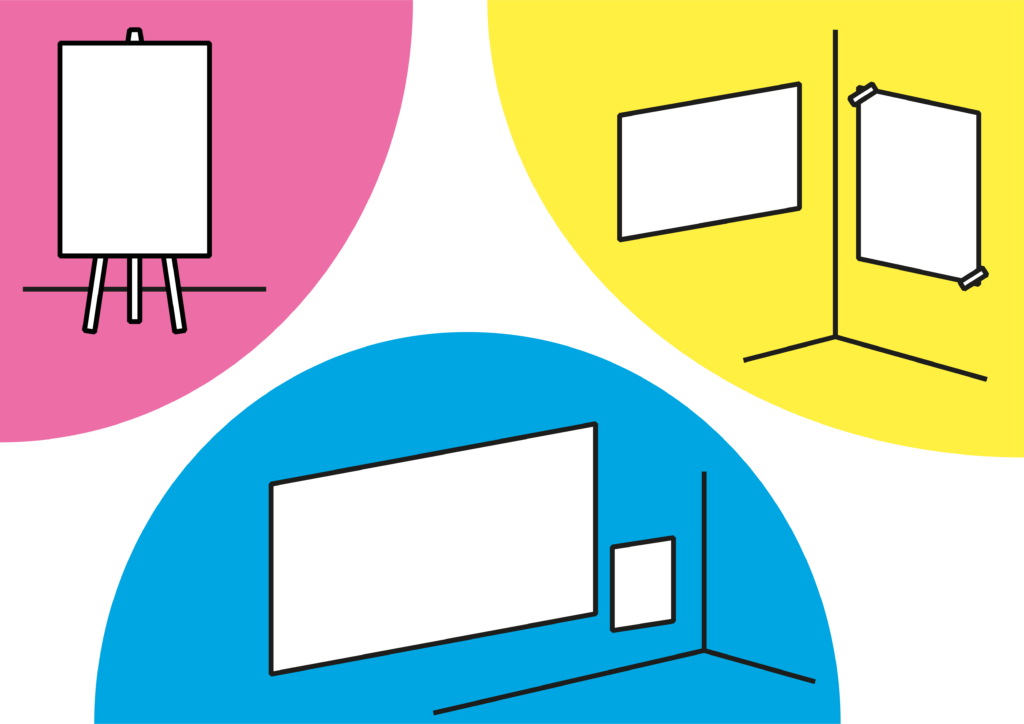
Think of “Walls”
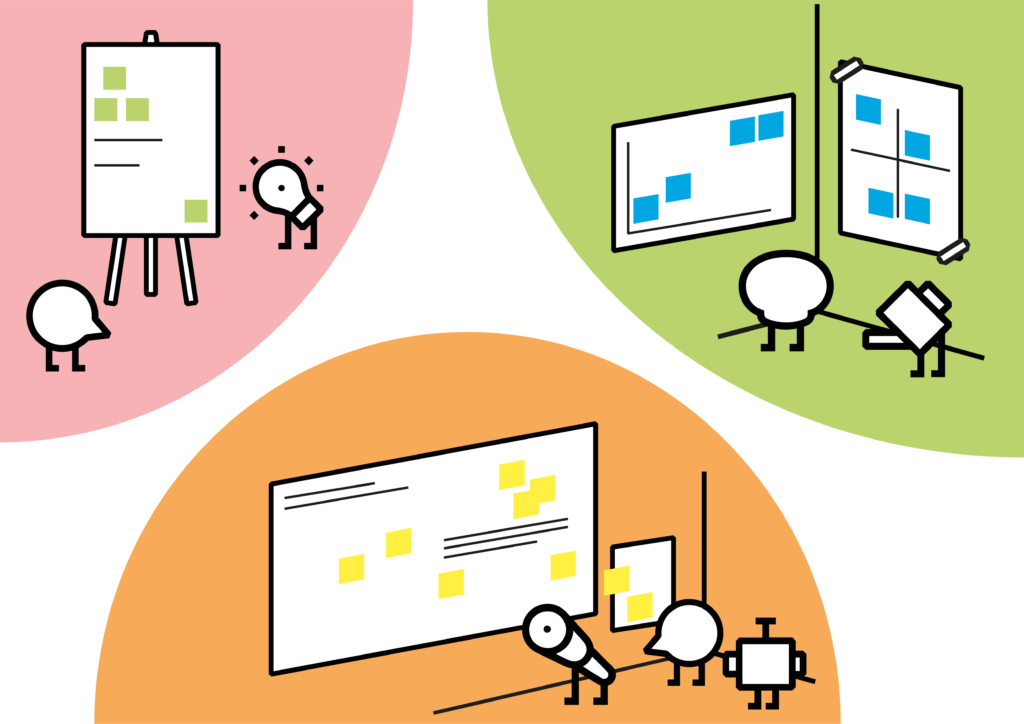
Flipcharts, pinboards, etc. are collective brains and create transparency. Therefore, use them consciously in all phases of the workshop.
- Visualize the purpose and desired outcomes: This way, they remain present for all participants as guiding principles.
- Formulate tasks clearly and in an activating manner. Each task should be understandable to every participant without the need for your “translation assistance” and explanatory words, so that they can work independently without your intervention.
- Post results immediately – visualized and formulated in a way that is as self-explanatory as possible. This allows everyone (even those who were not involved in a result) to build on what has already been developed.
- Make room for the unplanned. Not everything relevant can be planned, but it hinders the flow if there is no room for it. (Question flip, open points, interfaces to other topics, etc.)
- Work with clusters, headings, colors (e.g., for coding – always use yellow Post-its for work, larger blue ones for headings, and orange ones for questions).
- Let processes grow visibly
With good visualization, the “walls” become a truly helpful documentation of the workshop rather than a graveyard of photos.
Pitfalls
- The conference room prison: Large table in the middle, no one moves, everyone stays seated.
- Too much rearranging during the workshop: Constant furniture moving destroys flow. Plan the transitions as well.
- Not using walls: When results disappear into notebooks, they lose their collective impact.
- Space ignores hierarchies: The boss sits at the head of the table? That’s no coincidence. That’s architecture.
- Rooms that are too comfortable: Sofas are great. But not for decision-making processes.
A basic principle
Ein gemeinsamer transparenter Arbeitsraum – keine isolierten Gruppenräume.
Alle oben genannten Informationen lassen sich auch in remote Settings übertragen, bis auf Gruppenräume. Kleingruppen-Arbeit / Breakouts erfolgen immer in isolierten Räumen.
Additional Resources
McCandless, Keith, and Henri Lipmanowicz. The Surprising Power of Liberating Structures: Simple Rules to Unleash A Culture of Innovation. Seattle: Liberating Structures Press, 2014.
Doorley, Scott, and Scott Witthoft. Make Space: How to Set the Stage for Creative Collaboration. Hoboken: Wiley, 2012.
Kolb, David A. Experiential Learning: Experience as the Source of Learning and Development. Upper Saddle River, NJ: Pearson Education, 2015.
IDEO U. “Designing for Collaboration.” Accessed February 23, 2026. https://www.ideou.com/blogs/inspiration/designing-for-collaboration
Liberating Structures – Space and Structure Principles:
https://www.liberatingstructures.com
Quellen
cidpartners. Prinzipien dynamischer Zusammenarbeitsformate – Essenz-Karten. 2014.
Gruber, Karl, und Gerber. Flow-Team Forschung – Überblick. 1999. (Quelle laut Abbildung „Flow-Team Forschung – Überblick“).
Tacke Consult. Der Arbeitsprozess in der Flow-Methode sowie Grundprinzipien Flow-Methode. (siehe beigefügte Abbildungen).