

Background
Difficult conversations rarely escalate because of a subject matter. They escalate because of the mindset we bring to them. In tense situations, we quickly slip into unconscious patterns of thinking and behavior. Two typical cognitive biases accompany us quite reliably in these situations: We confuse effect with intention (“He hurt me” becomes “He wanted to hurt me”), and at the same time, we believe that our own good motives (intentions) automatically mitigate the impact of our actions. Both can lead us to feel morally superior.
You can find further information in Eric Berne’s transactional analysis framework. It describes how people in conflicts often slip into the position: “I’m OK, you’re not OK.” From this stance, the conversation becomes an implicit trial. I argue, prove, and explain, while you defend yourself.
The result is the familiar “push and pushback” pattern: the more I push, the harder you push back. The conversation becomes a contest of wills between two truths. Tension in the relationship rises, while understanding diminishes.
The alternative is the mature attitude: “I’m OK, you’re OK.” This doesn’t mean we agree. It means we assume that both perspectives have their own internal logic. That both people are fundamentally people of integrity, even if their current viewpoints clash.
Prof. Fred Kofman’s approach builds on this very idea. He assumes that we only ever perceive reality in fragments. Each of us sees only part of the picture. Only when we are willing to turn around and ask with curiosity, “What do you see that I don’t see?” does genuine dialogue emerge.
Difficult conversations are therefore not a rhetorical discipline, but a matter of consciously interacting with one another. Connection comes before content. Relationship comes before solution. And only when I can withstand my own tension without resorting to attack or withdrawal does a conflict become a shared space for reflection.
With this mindset, the conversation truly becomes a tango: not a battle, but a mutual give-and-take — with the goal of understanding the other person’s perspective and moving forward together.
The Process – Step by Step
Phase 1 – Inner Preparation (Appreciate)
A difficult conversation always starts with you. Before you speak, ask yourself the following:
What are the verifiable facts, and what is my interpretation? What emotions do I bring to the table? What assumptions do I make about the other person’s intentions? And what do I actually want to achieve?
- for me (i),
- for our relationship (we) and
- for the cause (it)?
The key questions are: Do I want to be right, or do I really want to understand? And am I willing to consider a solution that I hadn’t previously considered?
Phase 2 – The Tango of Perspectives (Orchestrate)
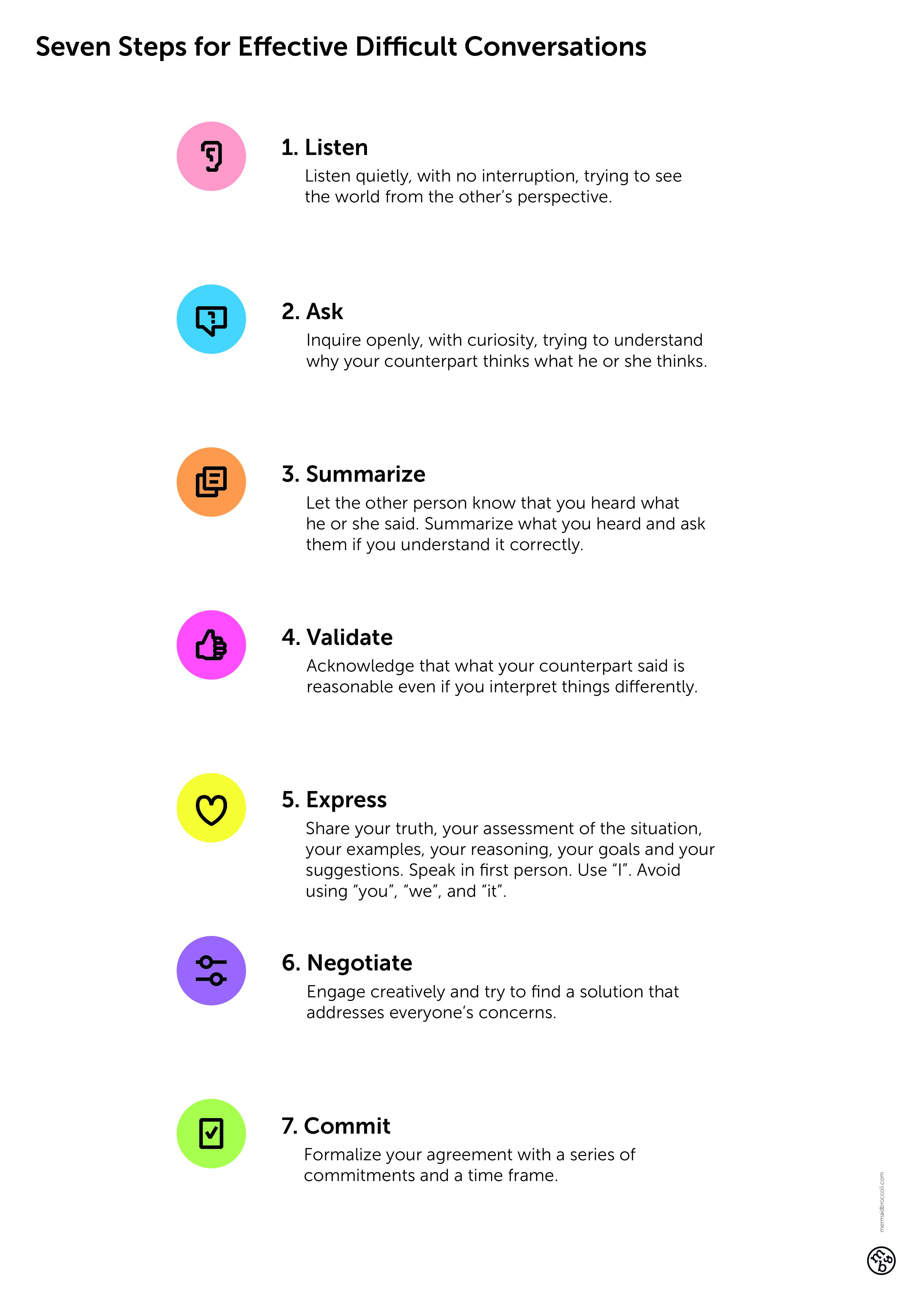
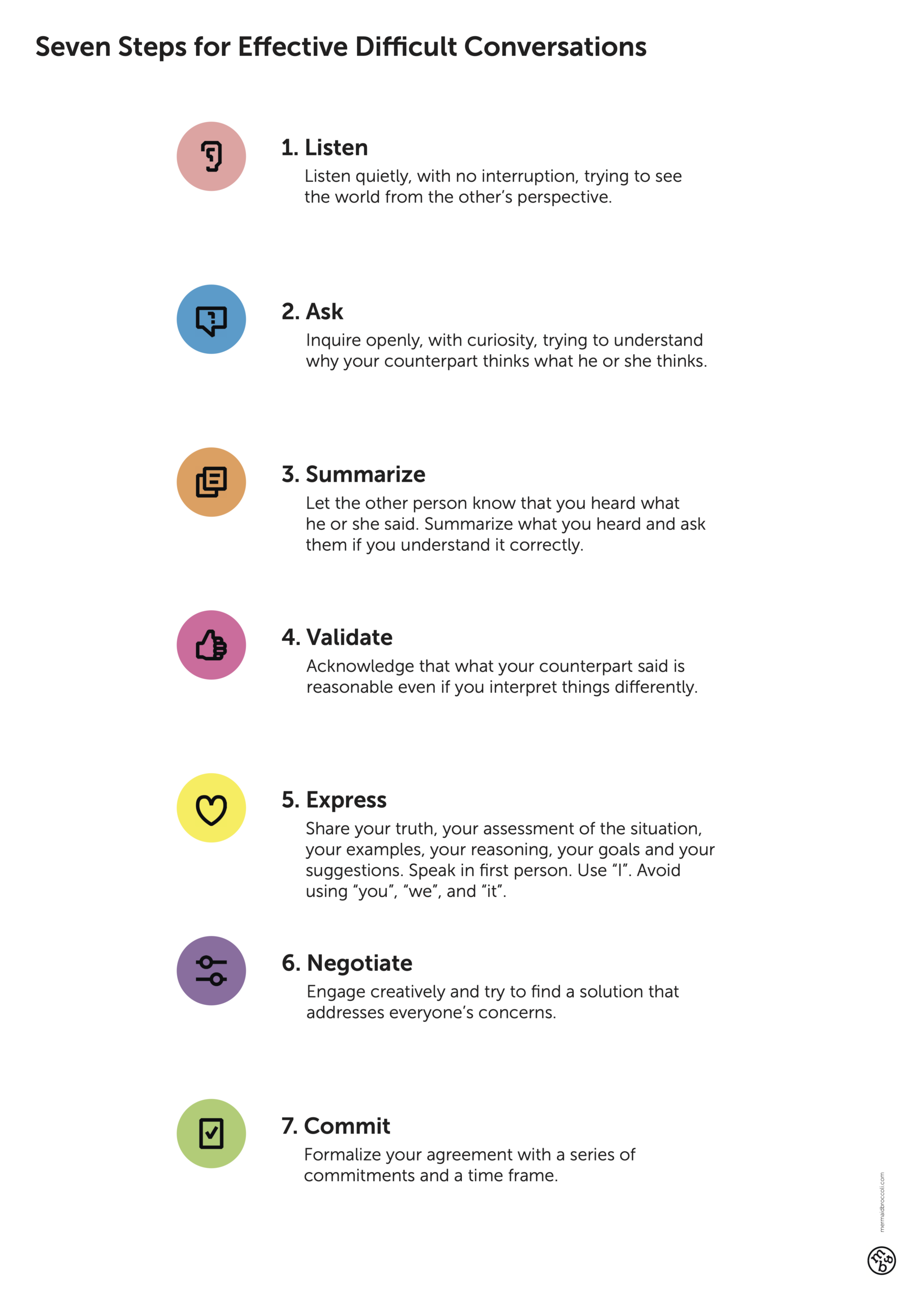
The conversation itself follows the “Tango of Perspectives.” This is where the 7 steps for effective difficult conversations come into play.
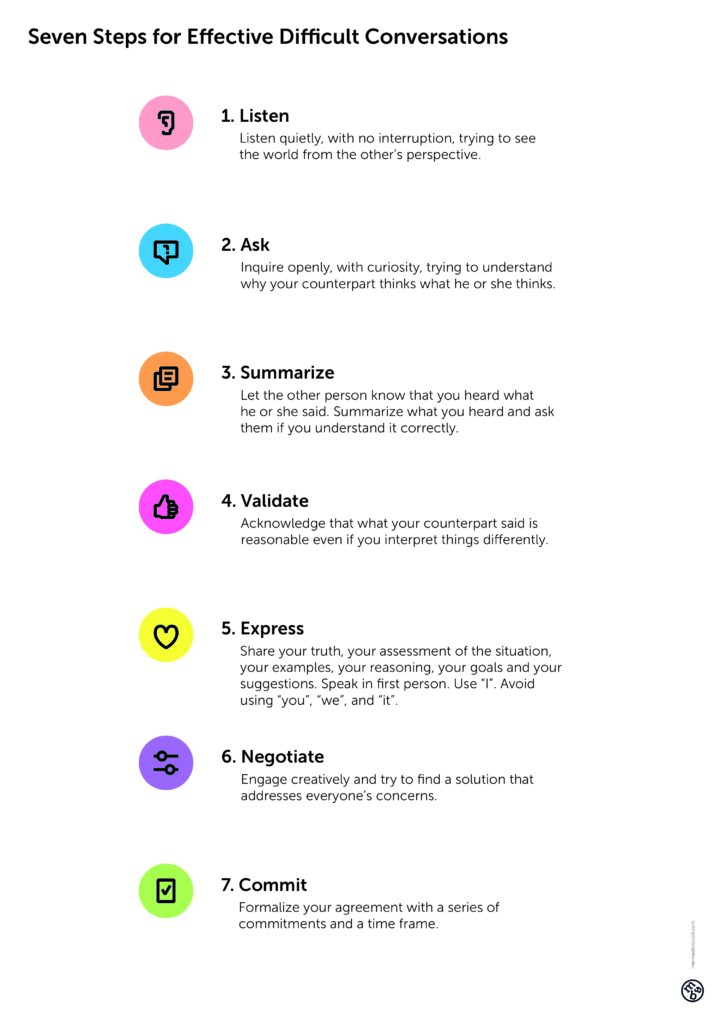
First, listen. Really listen—without interrupting the other person and without forming a counterargument in your head. Try to see the world through the other person’s eyes. Then ask questions out of genuine curiosity. Not to expose weaknesses, but to understand the logic behind the other person’s perspective. Finally, summarize what you’ve heard and check to see if you’ve understood correctly.
This is followed by validating: By doing so, you acknowledge that the other person’s perspective makes sense from their point of view. You are not expressing agreement, but rather respect for their reality. Only then do you share your own perspective — clearly, specifically, and in the first person. “I perceive…,” “I experience…,” “I wish…”. No accusations, no generalizations. Remember, your truth is not the absolute truth.
Now it’s time to start thinking together: creatively, solution-oriented, and as equals. You look for a way that takes into account the concerns of both sides. And finally, you reach clear agreements: Who does what by when? Without clear commitments, even the best conversation will have no effect.
After the conversation, it’s worth taking an honest look back: Have I stayed true to my values? Is our relationship stable — or has it even grown stronger? Have we cleared things up? And where might I have slipped back into my old pattern of push and pushback?
Difficult conversations aren’t a skill you learn once and then consider done. They are the practice of building relationships. And as such, they are new every time and always an invitation to move from conflict to cooperation.
Source:
Kofman, Fred. Conscious Business: How to Build Value Through Values. Boulder: Sounds True, 2006.
Kofman, Fred. The Meaning Revolution: The Power of Transcendent Leadership. New York: Crown Business, 2018.
Stone, Douglas, Bruce Patton, and Sheila Heen. Difficult Conversations: How to Discuss What Matters Most. New York: Penguin Books, 2010.
Kofman, Fred. Conscious Business: How to Build Value Through Values. Boulder: Sounds True, 2006.
Kofman, Fred. The Meaning Revolution: The Power of Transcendent Leadership. New York: Crown Business, 2018.
Stone, Douglas, Bruce Patton, and Sheila Heen. Difficult Conversations: How to Discuss What Matters Most. New York: Penguin Books, 2010.
RELATED METHODS
Conflict Resolution TypesFive dysfunctions of a team (based on Patrick Lencioni)
Inner Team
DOWNLOADS
Handout “7 Steps for Difficult Conversations” for digital whiteboardsPoster “7 Steps for Difficult Conversations” for printing
Poster “7 Steps for Difficult Conversations” for digital whiteboards
Handout “7 Steps for Difficult Conversations” for printing