
Background
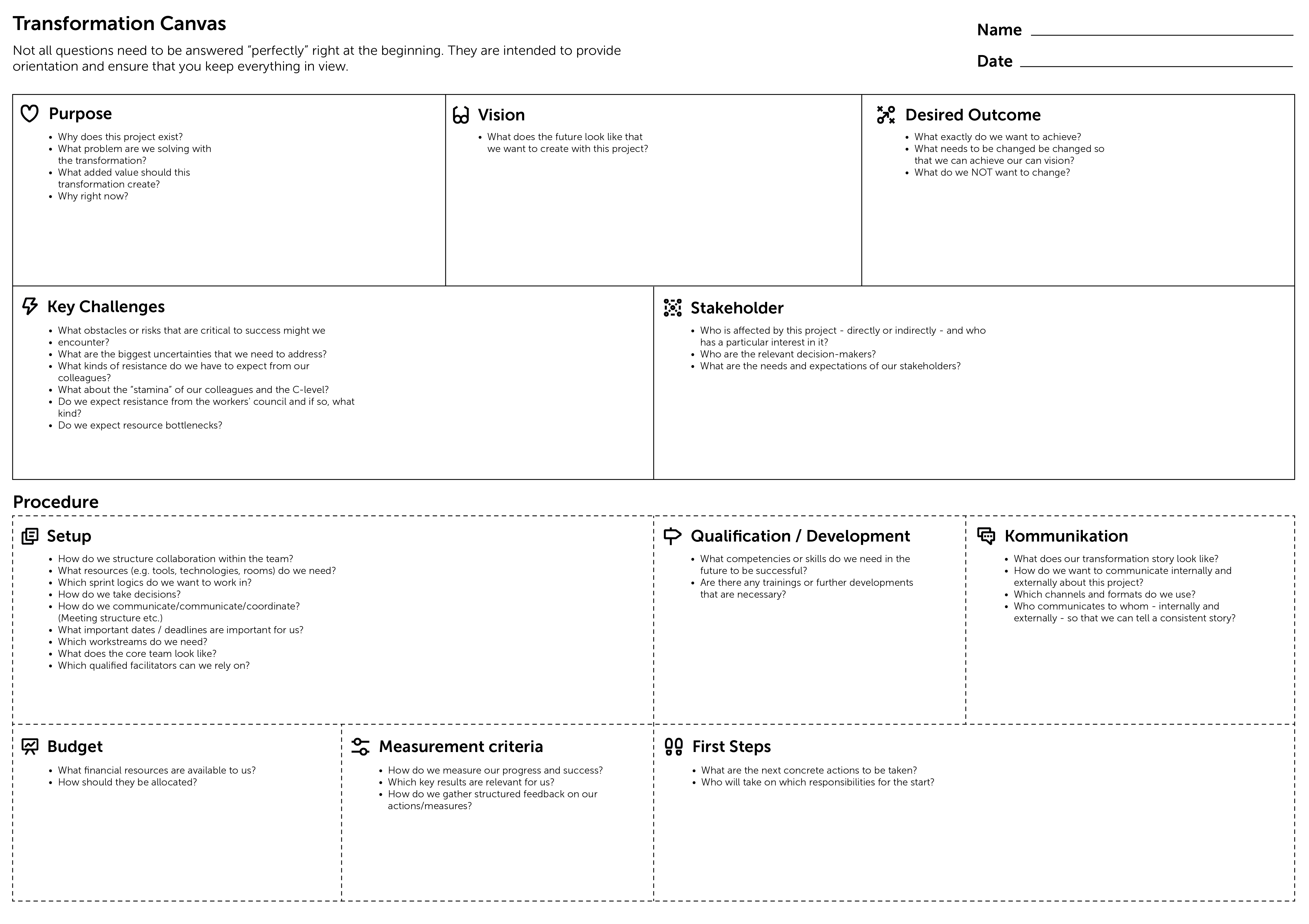
The Transformation Canvas is based on the Change Canvas developed by various experts in the field of change management and agile transformation. We have added some fields that are necessary for transformations (compared to change projects). And we often use it in workshops with teams and managers to prepare for upcoming transformations.
Like all canvasses (see Working with a canvas), this canvas is based on the principles of visualization, co-creation and transparency. This makes it easier for teams to tackle complex changes in a structured and collaborative way.
Step-by-step Instructions
First Part of the Canvas
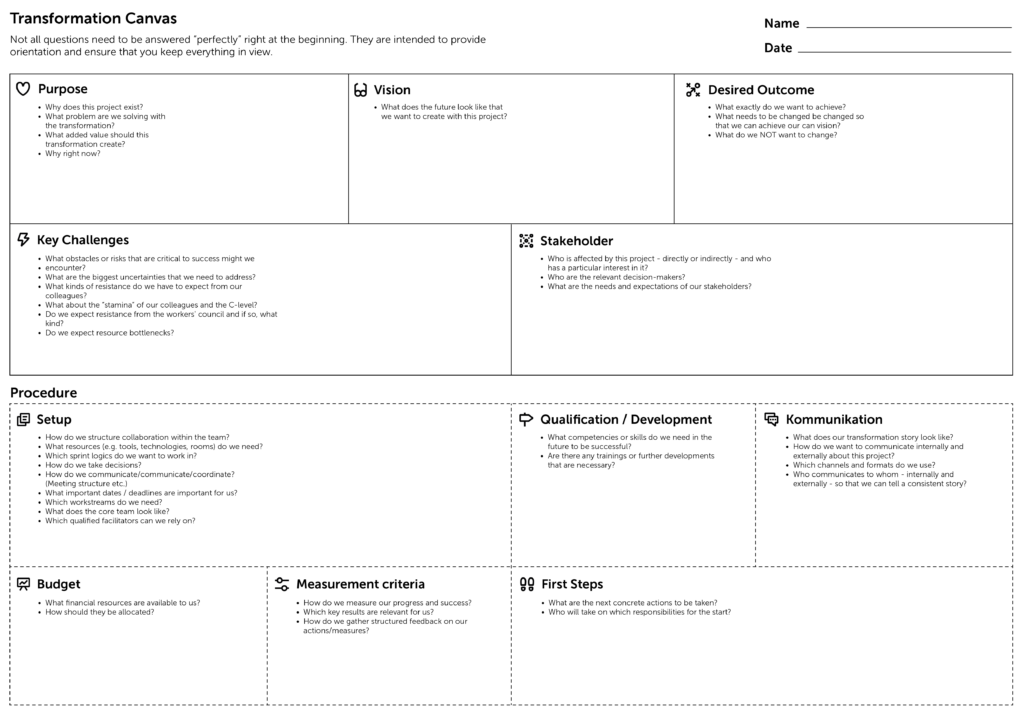
The upper part of the canvas helps to develop the “big picture”. This part is ideally developed by the core team (Transformation Architects) together with the Transformation Facilitators.
- Purpose
The purpose explains why this transformation should take place at all. Who will benefit from it and how? Where does the urgency to act now arise from?
- Vision
At the beginning, the vision for the transformation process must be clearly defined. The aim here is to clarify what the future should look like in concrete terms. The vision is the guiding star for all further steps and should be clear and understandable to everyone involved. Even if you do not know exactly how to get there, it is important to describe the “ideal state” as clearly as possible.
- Desired Outcome
It is necessary to be clear about what should change – and what should not. Should processes be changed, structures adapted or even the entire business model transformed? It helps to be as specific as possible here.
- Stakeholder
Identify all relevant stakeholders. Who is affected – directly or indirectly? What are the needs and expectations of the most important stakeholders? Who are the decision-makers, who are the implementers? Stakeholders should be analyzed according to their role and influence in the process so that their expectations and needs can be taken into account. (see Stakeholder Map)
- Key Challenges
What challenges critical to success are to be expected? These can be found on both a human and a factual level. Are there relevant stakeholders who could torpedo the project? Are there any technical challenges that need to be overcome? Are there resource bottlenecks that could hinder the transformation? An honest look at these critical factors makes it possible to look for solutions at an early stage and prevents you from being taken by surprise.
Second Part of the Canvas
Approach: How will the transformation unfold?
The lower part of the canvas focuses on the concrete approach. This is usually the task of the core team. However, the transformation facilitators can also provide support with this part.
- Set-up
The set-up describes how the change process is structured and managed. Who takes responsibility? Is there a core team that takes care of the design of the transformation process and holds all the threads together? Which phases are planned? Which deadlines are important to keep an eye on? If working in a sprint logic, how are the backlog and the necessary steps recorded? What decision-making mechanisms are used to keep the process agile and flexible? Which workstreams are necessary? Which important dates need to be kept in view? The clear assignment of roles is crucial here. - Budget
The budgetary framework should be clarified as early as possible. Is there a dedicated transformation budget? How should this be allocated? It is essential to take a regular look at this part of the canvas in order to take into account the changes that will certainly occur in the course of the transformation.
- Measurement criteria
It is important to define clear key results to measure the success of the change and to obtain continuous feedback on the approach and activities (see Prototyping and Gathering Feedback methods). Both qualitative and quantitative aspects should be taken into account. They provide information on whether the process of change is on the right track or needs to be adjusted.
It may also be possible to set up OKRs (Objectives & Key Results)
- Development and Qualification
Change often requires new skills, and a genuine transformation also means developing a new mindset. This step is about which qualifications are needed to successfully master the change and how employees and managers can change their attitude (mindset). What training, workshops or coaching is needed to prepare employees and managers accordingly?
- Communication
Continuous and transparent communication is crucial for the success of any change, and even more for transformations. What is the story to be told internally and externally? Which channels are used? How is it ensured that all those involved are regularly informed and involved in the process? The way in which feedback is collected and integrated into the process is also specified here.
- First steps
Define the first, concrete steps. These are small, easy-to-implement measures that can be tackled immediately to start the transformation. The focus here is on a quick start that creates the momentum for further measures.
Conclusion
The transformation canvas is a living document that is constantly adapted during the course of the transformation process. It helps to maintain an overview, clarify open questions and steer the process in a transparent and targeted manner.
RELATED METHODS
Working with CanvasesQuick Introduction to OKR (Objectives & Key Results)
Prototyping
Gathering feedback
Stakeholder Map