
Background
Everyone has their own way of thinking, acting and communicating. Misunderstandings or conflicts often arise because expectations and needs remain unspoken. A personal instruction manual helps to avoid these pitfalls by clearly formulating what makes you tick and what you need from others. The method promotes openness, trust and self-confidence.
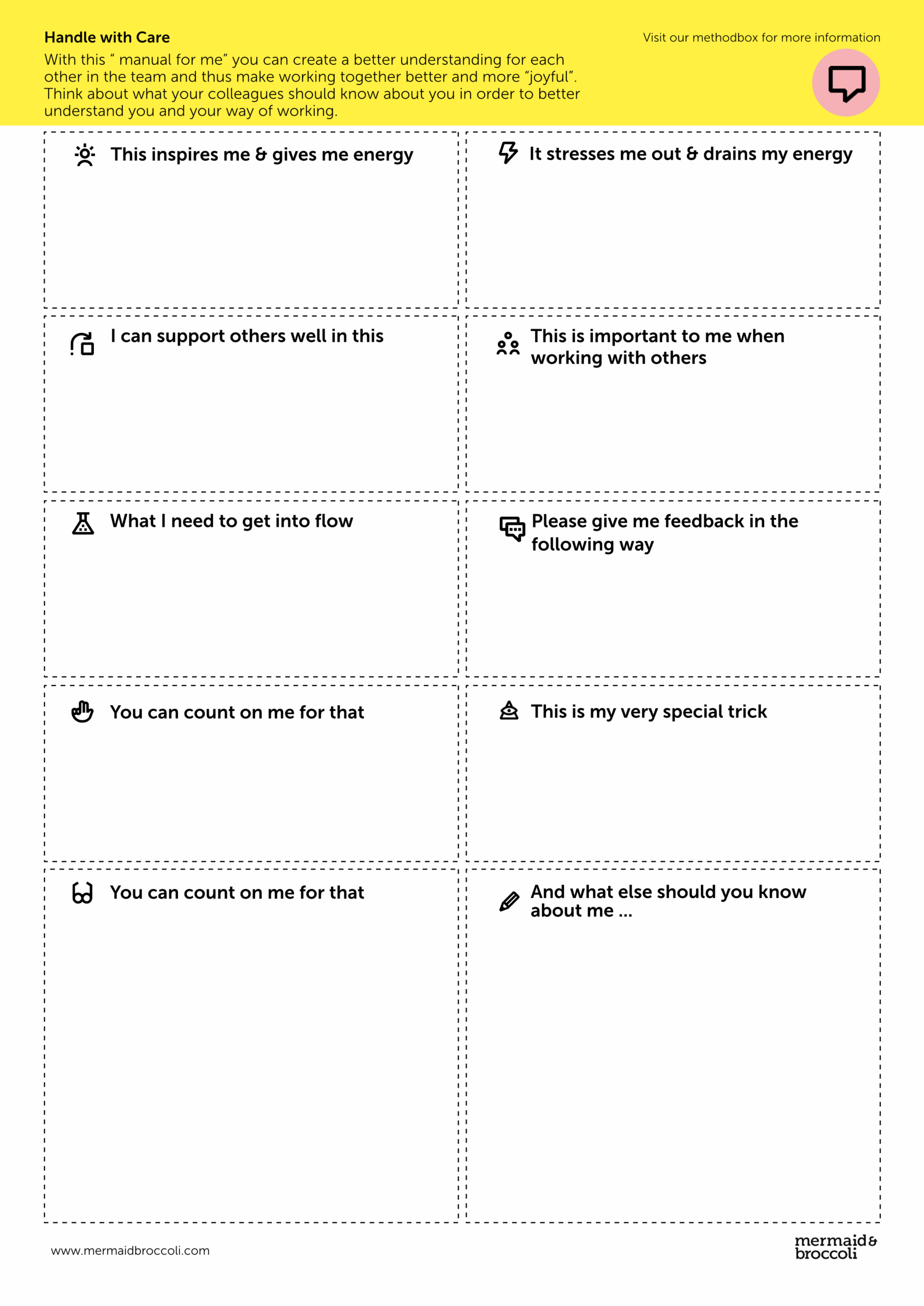
Step by step instruction1. Reflection Phase: Filling the template
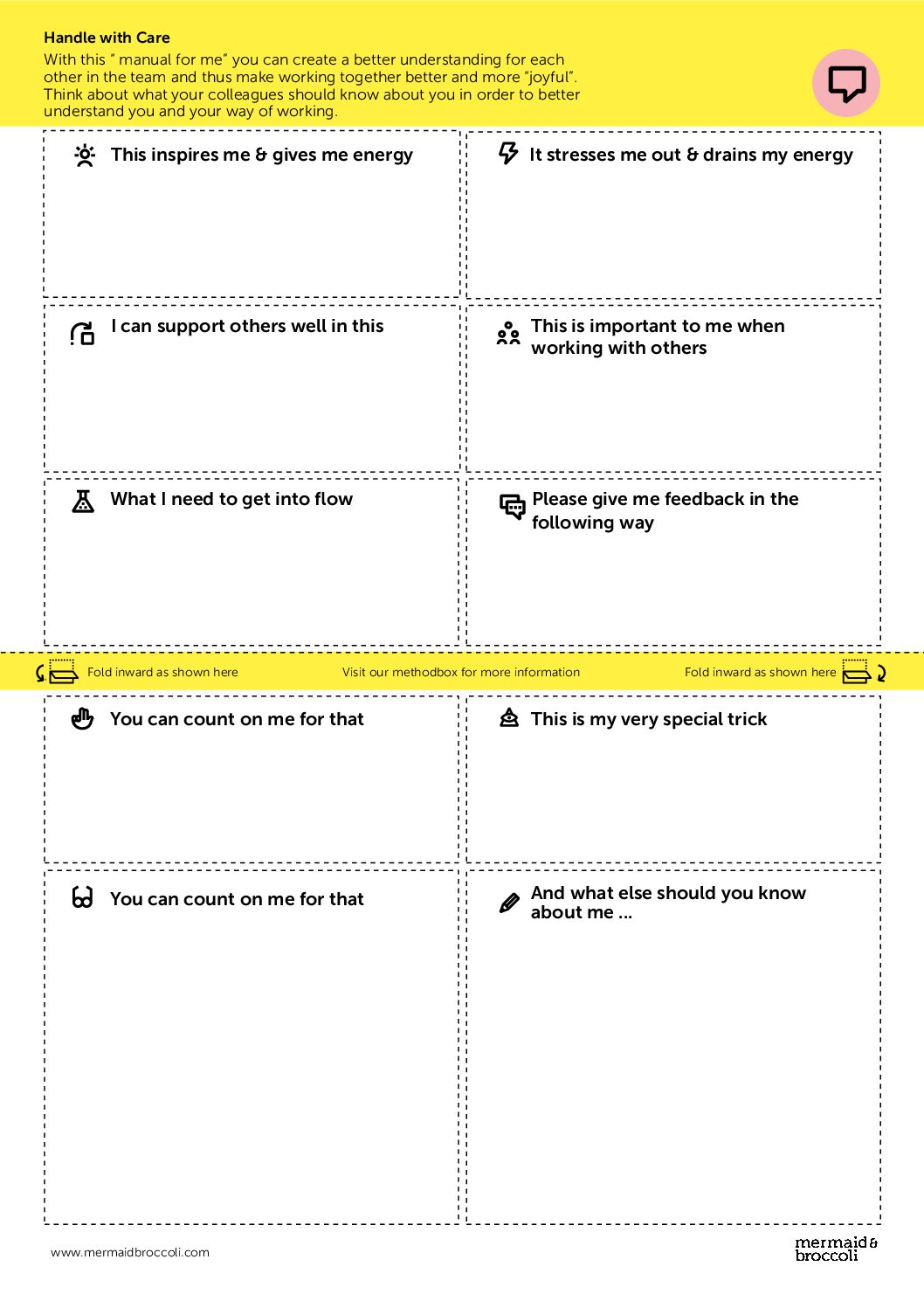
Everyone reflects on the various aspects and fills in their own template.
- This inspires me & gives me energy
E.g. other people, developing new ideas together, learning new things - It stresses me out & drains my energy
E.g. endless discussions that go round in circles forever - I can support others well in this
E.g. preparing workshops, thinking outside the box - This is important to me when working with others
E.g. Open and honest interaction with each other and appreciation of our differences - What I need to get into flow
E.g. time for myself with few distractions - Please give me feedback in the following way
E.g. Preferably in a small group and with a clear “why” - You can count on me for that
E.g. new ideas, loyalty - This is my very special tick
E.g. I develop my thoughts while talking - This is my secret super power
E.g. making grumpy people smile, getting the right people to talk to each other - An here’s what else you should know about me
E.g. I get distracted very easily and tend to jump from A to F to P. You are welcome to find me back to A if that is important at that moment
2. Exchange within the team
Share your manuals with your team.
Depending on the size of the group, you can can proceed in different ways:
- Go into alternating groups of two and present your manuals to each other.
- You can also organize it as a “bingo”: Go around the room and look for colleagues who tick in a similar way.
Pay attention to similarities and differences – and make sure that you have really understood each other’s words. Perhaps the colleague has something to add. Make a note of what this means for your collaboration with the respective colleague. What can you do differently in the future to improve cooperation? The templates can then be hung up for everyone in the team to see or placed on a digital whiteboard.
For larger groups you can also hang up the templates directly for a “gallery walk” or place them on a digital whiteboard. All team members then have the opportunity to browse through the others’ manuals at their own pace and note down any questions or comments (e.g. That surprised me, Good to know, Thank you for sharing, etc.).
It is very helpful to look at the manuals from time to time in team meetings. Has mutual understanding improved? What has changed in the way we work together?
RELATED METHODS
Appreciative InquiryDOWNLOADS
Template for Handle with Care (Manual for me) – png for digital whiteboardTemplate for Handle with Care (Manual for me) – pdf for printing